
AI calling for logistics companies means letting an AI make the short, repetitive coordination calls a transport office makes all day: is your truck free tomorrow, can the godown take the load at 11, has the POD reached you, where is my consignment. With MySA Business, a campaign rings each person on your list with their own route, LR number or invoice, and your team gets a summary of every answer. Your dispatchers keep the calls that need judgement. Taxis and passenger trips are a different job, covered in AI calling for cab booking.
Where this work happens in India
A few kinds of towns carry more freight than most. The calls in each would go in the local language, set per campaign or per row in your file.
- Ports on the west coast. Navi Mumbai around the Nhava Sheva port (Marathi, Hindi), Vasco da Gama by Mormugao port (Hindi, Marathi, English), Mangaluru (Kannada) and Kochi (Malayalam).
- Ports on the east coast. Kolkata and Haldia (Bengali), Visakhapatnam and Kakinada (Telugu), Thoothukudi (Tamil).
- Inland hubs. Nagpur, at the centre of the country's road network (Marathi, Hindi), Hubballi-Dharwad (Kannada), and the warehouse belts around Delhi: Greater Noida, where a multi-modal logistics hub is being built at Dadri, and Kundli in Sonipat along the KMP expressway (Hindi, Hinglish).
- Coal and rail. Dhanbad and Bilaspur (Hindi), where freight follows the mines and the railway.
- The north-east gateway. Siliguri (Bengali, Hindi), Guwahati and Tinsukia (Assamese), with onward trade to the hill states.
- The northern routes. Pathankot and Jammu (Punjabi, Hindi), on the road north.
Call languages include Hindi, Hinglish, Marathi, Bengali, Assamese, Telugu, Tamil, Kannada, Malayalam and Punjabi. Hear each one on a test call before you run a list in it.
Vehicle checks with truck owners and drivers
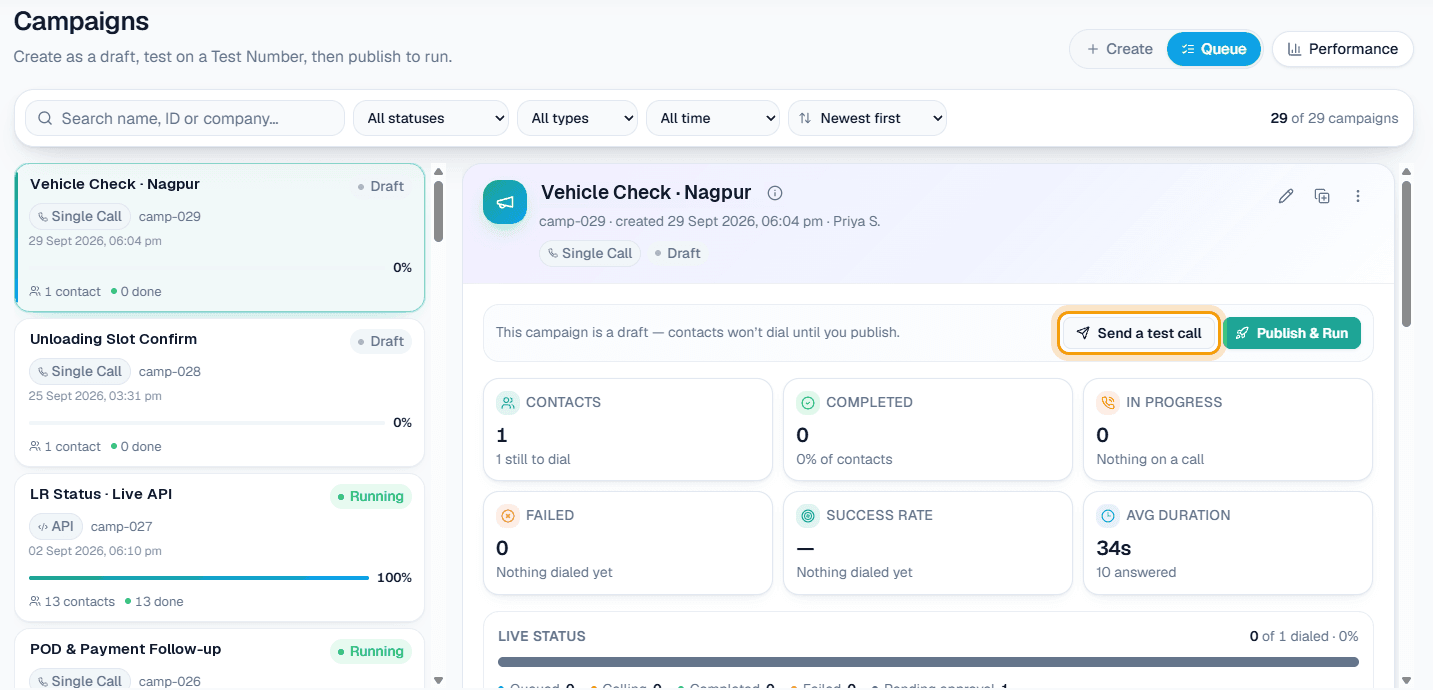
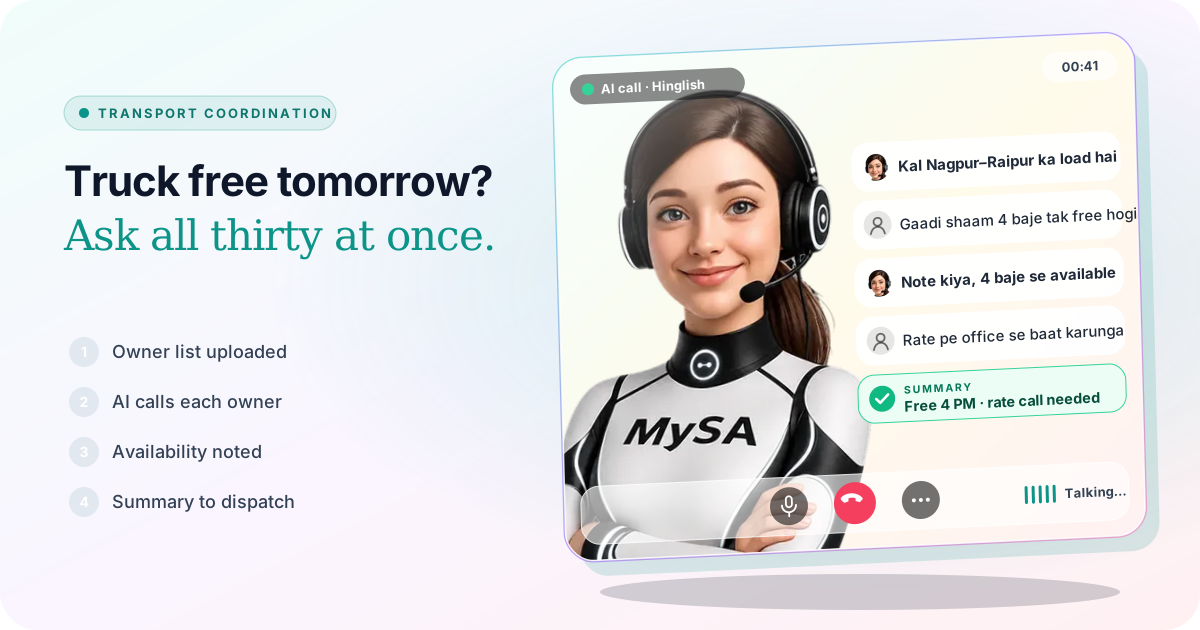
Every evening a transport office rings the same thirty truck owners to ask who is free tomorrow. Put that list in a .csv or .xlsx file with the owner's number in destination and the details in var1 to var15: route, load, date, vehicle type. Write the purpose with those columns in it, and a Campaign calls each one with his own load.
Example
AI: Namaste Sharma ji, main ABC Roadlines se bol rahi hoon. Kal subah Nagpur se Raipur ka 9 ton ka load hai, 19 feet gaadi chahiye. Aapki gaadi khaali hai?
Truck owner: Gaadi hai, par shaam 4 baje tak hi Nagpur pahunchegi. Aur rate pe baat karni hogi.
AI: Ji, note kar liya: gaadi kal 4 baje tak Nagpur, rate par aap office se baat karna chahte hain. Hamari team aapko call karegi.
ABC Roadlines is made up. After the call your team sees the AI summary ("Vehicle available from 4 PM, wants to discuss rate"), the sentiment, the tags and the recording in Call Logs. Because he asked for a person, the row lands in Follow-ups as Call from a person, and MySA never dials it again with the AI; your dispatcher rings him. If you set up call transfer with a "Dispatch" number and a When to transfer here line such as "when they want to discuss the freight rate", the AI can hand him over during the same call instead.
The AI can say the rate you put in the file. It does not bargain: the final rate is your dispatcher's call.
Unloading slots with consignees and warehouses
A truck that reaches a closed godown waits a day with a driver on the clock. A CSV Upload campaign the evening before can ring each consignee: "Kal LR 5521 ka maal 11 baje pahunchega. Unloading ho jayegi?" The consignee says yes, or "parso subah bhejo", or "receiving 2 baje ke baad", and that answer is in the summary.
This is different from telling a buyer their order is late; for that, see the order delay message. Here you are agreeing a slot before the truck leaves.
POD and payment follow-ups
A Scheduled campaign can take one file of unpaid bills and call it again every few days, skipping people already reached. Put the bill number, amount and due date in the variable columns, and the AI asks whether the POD reached them and when payment is planned.
When a client asks something the AI cannot answer from your Business Details, such as "TDS kaat ke bhejoon?", it promises to check and the row is marked Action required. You type the answer once, and the AI calls back with it. A client who says "Monday ko call karo" gets the call on Monday; read how to handle "call me later". The AI does not collect payment or send an invoice. It asks, and records the answer.
"Where is my consignment?" answered from your system
If your tracking software has an API, MySA can answer this from your own data. Under Integrations → My APIs, add your consignment-status API, tick Let the AI call this during a call, and write the When should the AI call this API? box plainly: "Look up a consignment's current status by LR number. Use it when the caller asks where their consignment is and gives an LR number." The LR number the caller says goes into your URL or payload, and the AI reads back what your system returns.
Attach the API to your business number under Phone system → Inbound, in Live data (your APIs), and the AI answers these calls for you; see Inbound calls. The Custom APIs docs list every field, and AI calls with real-time data walks through a full setup. During-the-call mode is enabled per workspace on request, and a workspace runs one mode at a time.
New freight enquiries called within a minute
A "get a quote" form filled at 10 PM is usually called by three transporters the next morning. With a Webhook campaign, the lead is dialled as soon as it arrives, usually within a minute. The AI asks for pickup and drop, weight, vehicle type and date, and the answers reach your team as a qualified enquiry. Max calls to one customer / day and Minimum gap between calls stop anyone being called too often. See Webhook campaigns and AI lead qualification.
If you run a courier franchise or a packers-and-movers site, Saathi can sit on your website as a video agent that answers visitors from the same Business Details and comes back with a summary of each call.
What callers say, and what the AI does
| They say | The AI does |
|---|---|
| "Gaadi kal shaam tak free hogi" | Notes the time in the summary for your dispatcher |
| "Rate pe baat karni hai" | Marks it for a person, or transfers to your Dispatch number |
| "Godown Sunday band hai" | Records the day the consignee can take delivery |
| "POD bhej diya, payment Friday tak" | Records the promised date in the summary |
| "LR 5521 kahan pahuncha?" | Looks it up in your API, if during-the-call mode is on, and reads the status |
| "Kal call karna" | Adds a follow-up at the time asked |
What works today, and what it does not do
| Works today | Does not do |
|---|---|
| Calls each truck owner, consignee or client with their own route, LR or bill from your file | Know who is free or what is due without your list |
| Reads consignment status from your own API during a call | Track a vehicle by GPS or a third party's system on its own |
| Notes availability, slots and promised payment dates in a summary | Negotiate freight rates or book a vehicle in your software |
| Hands a caller to your dispatcher with call transfer, in Live | Collect payment, send invoices or send SMS |
| Holds calls during your DND hours | Call a driver whose phone has no network on the highway |
These are scenarios, not customer stories.
Getting started
- Create a workspace and verify your mobile number to get ₹100 of Test credit in the separate Test environment.
- Approve your Business Details: routes you serve, vehicle types, office hours, the number clients should call.
- Press Try now: the AI rings your own phone, so you hear it in your language first.
- Upload a small list of five truck owners, test it on your own number, then go Live, top up the prepaid wallet and run the full list.
Calls of 10 seconds or less are free; longer calls are billed per started minute. The rate for your workspace is shown in the console. Talk to sales for volume pricing.