
An AI sales call script is the brief that tells an AI voice agent what a sales call should achieve: who it is calling, what to ask, what it may say about price, and when to hand the customer to a person. In MySA Business that brief is a purpose, not a line-by-line script the AI reads out. You write the goal and the rules once, attach your Business Details for the facts, choose the language, and every call in the campaign follows the same plan while still sounding like a conversation.
On 2 November 2026, Oman and the Netherlands met in Dubai in the final round of the ICC Men's Cricket World Cup League 2, an ODI tri-series that also includes the UAE. When the two sides met on 27 October, the Netherlands won by 106 runs. Neither is a Full Member of the ICC, and associate teams rarely have the budgets or depth of the big sides. What they tend to have is a clear plan for each spell. A small business running AI calls is in the same position: you will not out-spend a large call centre, but you can out-plan it.
Pick your playing XI: the five parts of a good purpose
A purpose that works on a sales call usually has five parts. Leave one out and the call drifts.
- Who you are and why you are calling. "You are calling from ABC Solar, about the rooftop solar form the customer filled." The Company name on the campaign is what the AI introduces itself with.
- The goal. One outcome, stated plainly: "Find out if the customer owns the roof and wants a site survey."
- What to ask. Two to four questions, in order. More than that and customers hang up.
- What to say about price. Either a rule ("give the starting range from Business Details, say the exact quote comes after the survey") or a clear "do not quote".
- When the call is done, and when to hand over. What counts as success, and what should happen when the customer wants a person.
Facts such as prices, branches, timings and warranty terms do not belong in the purpose. They go in Business Details, the knowledge the AI answers from. The purpose is the game plan; Business Details is the scorebook.
Before and after: the same call, two briefs
Most first drafts are either a sales pitch to recite or a single vague line. Here is the same solar enquiry written both ways.
| Part | Before | After |
|---|---|---|
| Opening | "Tell them about our solar panels." | "Introduce yourself from ABC Solar and mention the form they filled on our website." |
| Goal | "Sell solar." | "Find out if they own the roof and want a free site survey." |
| Questions | None written | "1. Roughly how much is the monthly electricity bill? 2. Is the roof their own? 3. Which day suits a survey?" |
| Price | "Tell them it is cheap." | "Give the starting price from Business Details. Say the exact quote comes after the survey. Never offer a discount." |
| Objections | None written | "If they say it is too costly, mention the subsidy information in Business Details once, then move on." |
| Handover | None written | "If they ask for a final quote or want to speak to someone, offer to connect them to Sales." |
| End | None written | "Thank them, confirm what happens next, and end the call." |
The "after" version is longer, but every line gives the AI a decision it would otherwise guess. It also gives you something to judge the call against: in Campaign analytics, Did the call do its job splits calls by whether the purpose's goal was Achieved or Not Achieved, which only means something when the goal is one clear outcome.
Field placement: what the AI should ask, and in what order
Set your field before the first ball. On a sales call, that means the questions that sort a serious buyer from a casual one, asked in the order a good salesperson would ask them:
- Need first. "Bill kitna aata hai?" before "kab lagwana hai?".
- Fit second. Own roof, budget range, city, the one condition that rules a lead in or out.
- Next step last. A survey, a showroom visit, a call from a person.
Write the questions in the purpose as a numbered list. If each contact needs something different, such as the product they enquired about or the branch nearest to them, add var1 to var15 columns to your contacts file and write {var1} in the purpose. A row that leaves a variable blank simply drops it from the sentence, so word the purpose so it still reads well without it. The details are in Campaigns.
The price question: play it from Business Details
Price is where AI sales calls go wrong most often, because a vague purpose leaves the AI to improvise. Two rules keep it safe:
- Write the price facts in Business Details, not in the purpose. The AI answers price questions from the category attached to the campaign.
- Say in the purpose what the AI may promise. "Starting range only", "no discounts", "exact quote after survey".
If a customer asks something the AI cannot find in your Business Details, it does not invent an answer. It promises to check, and the call appears in Follow-ups as Action required. You type the answer under Your answer (MySA will say this on the call), press Save & schedule call, and the AI calls back with it. See Follow-ups.
Bring on the specialist: when to hand over to a person
Some moments belong to a person: a final quote, a complaint, a large order. Decide them in advance.
With Call transfer set up under Phone system → Call transfer, each number gets a Name (Sales, Support) and a When to transfer here line, such as "when they want a final quote or a site survey". The AI picks the number by those words, briefs your colleague first in the Briefing language you chose, and then connects the customer. Transfer works in your Live workspace only, is set up by the workspace Owner, and has separate switches for Use on outbound calls and Use on inbound calls. Transfer minutes are billed separately at the rate shown on the card. More on choosing those lines in our guide to AI call transfer to a human.
Without transfer, a customer who asks for a person becomes a Call from a person follow-up. MySA never dials these itself, so someone on your team rings them back and presses Mark called back.
Languages: Hinglish is the default for a reason
The Language on each campaign defaults to Hinglish, which is how most urban Indian customers actually talk on the phone. The language a customer hears is the one you pick here, so write the purpose in plain words and let the dropdown decide the language. A language column in your contacts file overrides it for one contact, and Enforce speech language in step 2 of the campaign holds the AI to the campaign language instead of following the customer if they switch. For inbound numbers the same choice is Stick to the chosen language. Hindi and several Indian languages are in the dropdown; hear any of them on a Test call before choosing it for customers. Our guide to AI calling in Hindi and Hinglish covers the choice in more detail.
A sample sales call in Hinglish
Example: a rooftop solar enquiry
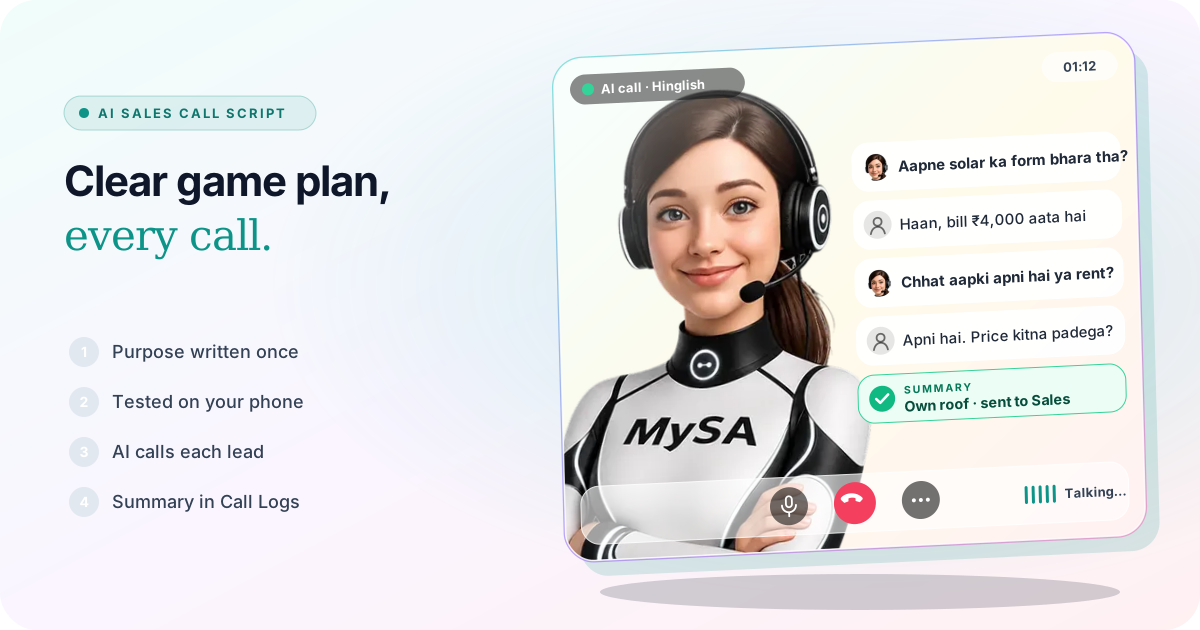
AI: Namaste Rahul ji, main ABC Solar se bol rahi hoon. Aapne hamari website par rooftop solar ka form bhara tha. Do minute baat ho sakti hai?
Caller: Haan, boliye.
AI: Aapka bijli ka bill mahine mein lagbhag kitna aata hai?
Caller: Garmiyon mein ₹4,000 tak aata hai.
AI: Aur chhat aapki apni hai, ya rent par hain?
Caller: Apni hai. Price kitna padega?
AI: 3 kW system ka starting price ₹1.8 lakh se hai. Exact quote site survey ke baad milta hai, aur survey free hai.
Caller: Theek hai, par main final quote kisi se baat karke lena chahta hoon.
AI: Bilkul. Main abhi aapko hamari Sales team se jod rahi hoon, unhe aapki details bata deti hoon.
ABC Solar and its price are made up; the AI quotes only what the business wrote in its Business Details. After the call, Call Logs holds the recording, the AI summary, the customer's sentiment and, for a transferred call, the AI and transfer charges separately. The person in Sales picked up already knowing the bill, the roof and the question.
Let the writer draft it, then edit like a captain
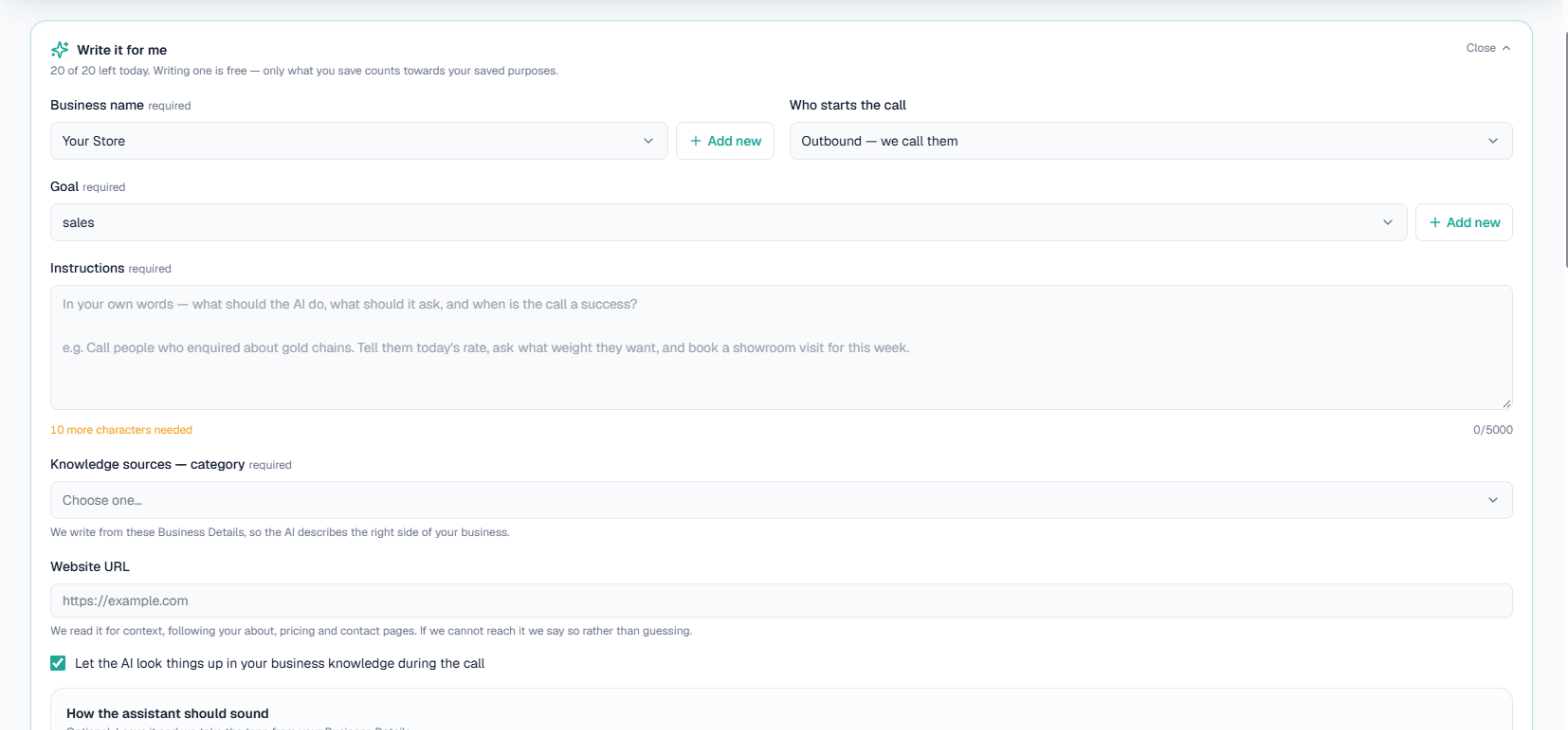
You do not have to start from a blank page. In Business → Purposes, the Write it for me writer asks for the Business name, Who starts the call (Outbound — we call them for sales campaigns), the Goal and your own Instructions, and can read your Website URL for context. About half a minute later a draft appears, unsaved, for you to edit, name and Save. It allows 20 drafts a day, and you can keep 5 saved purposes by default. The full steps are in Assistants and purposes.
Read the draft the way a captain reads the field before an over: is the goal one outcome, are the questions in the right order, is the price rule clear, is the handover written down. Then ring your own phone with Send a test call from the campaign's Queue tab, listen, and change one thing at a time.
What works today, and what it does not do
| Works today | Does not do |
|---|---|
One purpose shared by every call in a campaign, personalised with var1–var15 | Read a fixed script word for word; the purpose is a goal, not a recitation |
| Price and product answers from your approved Business Details | Quote prices or discounts you did not write down |
| An Action required follow-up when it cannot answer | Make up an answer to keep the call going |
| Transfer to a named number in Live, with a briefing first | Transfer on Test calls |
| Hinglish by default, with Hindi and other languages selectable | Promise how natural each language sounds; test it first |
| A goal judged Achieved or Not Achieved per call | Close the sale on its own; your team still does |
Getting started
- Create a workspace and verify your mobile number to get ₹100 of Test credit in the separate Test environment.
- Build and approve your Business Details, with prices and the terms the AI may quote.
- Write the purpose with the five parts above, or let Write it for me draft it.
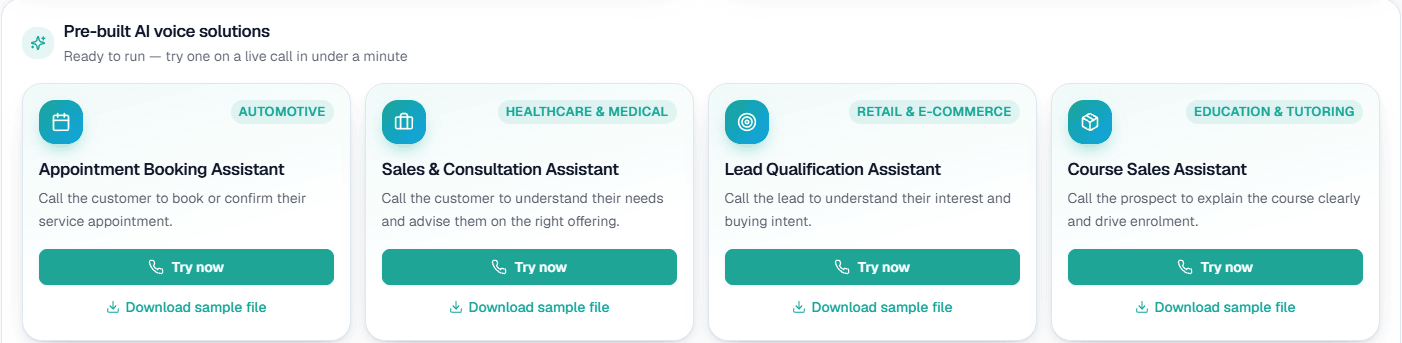
- Press Try now on a ready-made assistant to hear an AI call on your own phone, then Send a test call on your campaign.
- Go Live, top up the prepaid wallet, set up Call transfer if you want handovers, and publish the campaign.
Calls of 10 seconds or less are free; longer calls are billed per started minute. The rate for your workspace is shown in the console. Talk to sales for volume pricing. The overview of what the voice agent does is on AI voice agents, and lead questions are covered on AI lead qualification.